Generational Medicine: What Plants Carry Forward
read time—9:00
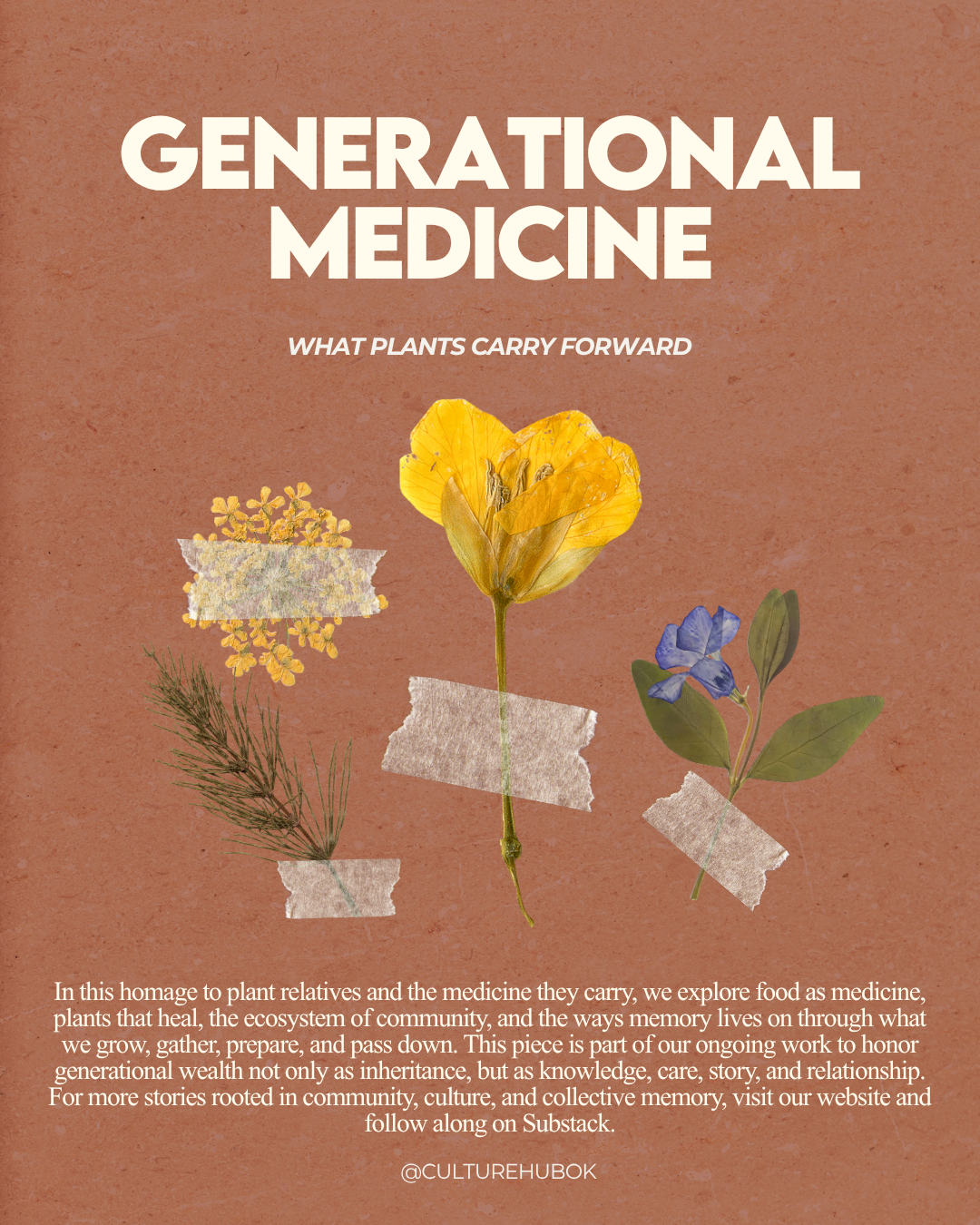
Generational Medicine: What Plants Carry Forward
Spring arrives slowly here. At first, it’s shy. The sun lingers a little longer each evening, the air softens just enough that your breath no longer hangs in front of you. The cold releases its grip quietly. And then, almost without warning, something begins to grow underfoot.
I notice it first in the body. The way warmth returns. The way I inhale a little deeper without thinking. And somewhere in that breath, memory follows—birdsong drifting through an open window, thunderclouds stretching wide across the sky, the feeling of something waking up again.
Spring has always felt like a kind of wonder to me. A faithful relative, returning on time, even when everything else feels uncertain. Its colors move across the landscape—fields, trees, flora, fauna—carrying something more than beauty. There is memory in it. Instruction. A quiet reminder of how life continues. When winter gives way, as it always does, I am reminded that everything moves in cycles. Not just the seasons, but us. Cycles that call us back to balance, to reciprocity, to relationship with Creator, and with the plants that have carried knowledge and healing long before us.
A few days ago, I walked into my neighborhood grocery store and was met with a different version of spring. Displays of pastel sweets and bunny-shaped crackers filled the aisles, bright and insistent. I passed them by. But as I stood in line, I noticed something else: cart after cart filled with flowers, wrapped in cellophane, their colors dulled under fluorescent lights.
I found myself wondering what people were really reaching for. Not just the color. Not just the season. Not even the flowers themselves. Something deeper—something like connection.
But recognition without relationship can only go so far.
For many of us, plants have been reduced to decoration. Something placed in a vase, ordered online, or tended casually as a hobby. A bouquet in a cart. A remedy in a bottle. A garden as something optional.
But that is not our story.
For Indigenous people, our relationship with plants has never been casual or separate from who we are. Plants are not simply things we grow or consume. They are relatives. Teachers. Living archives. They carry forward what could not be written down, holding instruction for how to live, how to heal and how to remain in right relationship with the world around us. They are our generational wealth. The kind passed from plant to elder, elder to child, generation to generation. The kind rooted in patience, in care, in giving without expectation of return.
So as the seasons turn, year after year, I find myself asking a different question. Not just what is sprouting again, but what is being carried forward. What do plants remember—and how do we learn to listen?
And in conversation with four people, each carrying their own relationship to plants, food and medicine, I began to understand something more clearly: this knowledge was never lost. It was waiting.
Often, it begins in the most ordinary place—the kitchen.
Food as Medicine
In Nico Albert Williams’s (Cherokee Nation of Oklahoma) kitchen, food moves with intention. There is a rhythm to it—ingredients gathered, prepared and shared in ways that feel both familiar and deliberate. The work does not present itself as instruction, but it teaches all the same.
She grew up learning how to read the land—gardening, camping, watching her family move with the seasons. Watching her grandmother tend peppers, learning what it meant to care for something that would eventually feed you.
Food, here, is not just sustenance. It is a form of memory.
“The medicine isn’t just the ingredients,” she says. “It’s the people you prepare the food with.”
Meals become a way of reconnecting—not only to ingredients, but to the histories that shaped them. The absence of certain foods. The reintroduction of others. The quiet rebuilding of something that was interrupted.
Sometimes that work looks like a shared table. Sometimes it sounds like conversation about where food comes from, how it is prepared, why it matters. And sometimes it is something simpler. Someone tasting something and recognizing it. Feeling, maybe for the first time, that nourishment can also feel like belonging.
Food sovereignty, in this space, is not abstract. It is practiced.
Alongside that work, Amy Warne (Mvskoke, Seminole) approaches food through a lens that bridges science and tradition. Her understanding of food is rooted in lived experience as much as it is in study.
“There were a lot of times where I was hungry growing up,” she says. “I could feel it on a cellular level that I needed nourishment.”
That knowing—felt in the body before it was ever explained—shapes how she speaks about food now. She talks about how food supports the body; how it regulates energy, nourishes systems and contributes to long-term health. But she is equally attentive to the conditions that shape what people are able to eat in the first place.
“They knew they couldn’t beat us in war, so they attacked our food,” she says. Food, she reminds, is never just about individual choice. It is shaped by access, by history, by systems that have distanced people from the foods that once sustained them. She points to the plants many people overlook—lamb’s quarters, wild onions, dandelion. Plants that are often pulled, discarded, mistaken for weeds.
“People don’t even know what’s growing around them,” she says. So the work becomes something more than education. It becomes restoration.
Restoring an understanding that food carries memory. That it can disconnect or reconnect us, depending on how we engage with it. And that reconnection has to be possible, grounded in what people can actually access and sustain.
“Everybody deserves access to nutrient-dense, nourishing food,” she says. Between Nico’s kitchen and Amy’s work, something becomes clear.
Food is not separate from plant medicine. It is the beginning of it.
Plants That Heal
For some, that beginning deepens into relationship. In Pam Vrooman’s (Citizen Potawatomie) practice, plants are part of the environment that makes healing possible. “Most of psychology is built on Western European frameworks,” she says, noting that those models often fail to account for histories of displacement and disconnection from land and community.
So her work begins differently.
Before a session starts, there is a pause. Clients are invited to choose a tea—nettle and mint for energy, raspberry leaf for support, chamomile for calm. They pour hot water, sit and take a moment to check in with their bodies.
“The act of making tea, choosing something for yourself, holding something warm; you’ve already created ceremony,” she says.
Sometimes there is smudging. Sage to clear what feels heavy. Cedar, for a covering of protection.
The space shifts.
Plants, in this setting, are not passive tools. They are participants.
“Each plant is a living being with a spirit,” Pam says.
That belief extends beyond her practice and into how she engages the natural world. Plants are spoken to before they are harvested. Gratitude is offered. What is taken is explained.
Because, as she puts it, “they’re willingly giving up their lives to help prolong ours.”
She recalls one experience that reshaped how she understood that relationship.
An elder had instructed her to harvest a plant growing on a hillside. When she arrived, the plant was covered with bees. She hesitated, unsure how to proceed. But the guidance she had been given was clear: greet the bees in her language, explain why she was there and ask permission to take only what she needed.
So she did.
One bee broke from the swarm and hovered in front of her. Then, just as suddenly as they had gathered, the bees lifted.
The plant was clear. She harvested a single stem, left tobacco in thanks and walked away. Behind her, the bees returned.
“It was the first time I felt all my relatives in a visceral way,” she says. Not as an idea, but as something lived.
That understanding of relationship is echoed in the work of Callie Amanda Belle Palmer (Black, Choctaw, Mexican) in everyday ways.
“Plants are everywhere around me all the time,” she says. “I use them every single day.”
Her relationship with plants didn’t begin in a formal setting. It began outside, wandering family land after church, noticing what was growing, what was changing, how the seasons moved through grasses, trees, and animals. Over time, that awareness deepened into practice. Plants moved into everything: food, teas, water infusions, body care, hair care. Not as something separate from daily life, but as something woven into it.
“Even a small harvest can stretch so far,” she says.
That knowledge, she later learned, was not new. The women in her family had carried it long before her.
“My Matriarchs used plants to help women give birth,” she says. It is a lineage of care—practical and deeply rooted. Not something hoarded, but something shared. And that sharing becomes part of the medicine. A handful of herbs passed to a friend. A tea made for someone who needs rest. Small acts that ripple outward. Through noticing what grows and where. Through understanding when something is ready to be gathered and when it should be left alone. Through harvesting in ways that do not deplete, but sustain.
Take what is needed. Leave what remains. Ensure that something continues for the plant, for the land, for what comes next.
Plants, in this sense, are not only medicine because of what they do to the body. They are medicine because of what they require from us.
Plants in the Ecosystem of Community
That responsibility extends beyond individuals. Our plant relatives exist within systems of soil, water, pollinators and seasons. But also within communities. In gardens where food is grown collectively. In seeds returned to the people they came from. In elders sharing knowledge with younger generations. Learning, in this context, is not isolated.
These relatives become more than resources. They become infrastructure, supporting not just physical health, but cultural continuity and collective survival.
Returning
I think about this often in my own work as a floral designer, surrounded by natural materials that are here for a moment and then gone. In the way seasons dictate what is possible. In the way certain materials return, year after year, carrying something familiar with them. There is something instructive in that rhythm.
Something about what it means to hold things temporarily, while still being part of something continuous. Because that is what this is. Not a return to something untouched, but a continuation. Knowledge that persists, wealth that compounds, healing wherever accepted.
Community & Continuation
Generational Medicine: What Plants Carry Forward is part of an ongoing community archival series.
This piece was written by Lauren Palmer, an Afro-Indigenous multidisciplinary artist and community archivist based in Oklahoma. Her work explores the intersections of land, lineage, ceremony and creative practice, with a focus on how knowledge is carried forward through generations.
Further Connections
This work is rooted in conversation and community. To learn more about the individuals whose voices are included here:
Nico Albert Williams
Nico is an Indigenous chef, educator and founder of Burning Cedar Sovereign Wellness, a community space centered on food sovereignty, land-based knowledge and cultural reconnection.
For more on her work, visit burningcedar.org and follow her ongoing projects through public programming, media appearances and community gatherings.
Amy Warne
Amy’s work centers on food as medicine, prevention-based health and restoring access to nourishing, culturally relevant foods.
To learn more about her work and ongoing teachings, follow her on Instagram and stay connected to her community-based initiatives.
Pam Vrooman
Pam is an Indigenous clinical psychologist whose work focuses on decolonizing care through the integration of plant medicine, ceremony and community-informed healing practices.
To learn more about her work, follow her public platforms and community engagements.
Callie Amanda Belle Palmer
Callie’s work explores everyday plant medicine, ancestral knowledge and community care through accessible, relational practices.
You can follow her work at Callie Belle’s Remedies and through her creative practice with The Wild Mother Creative Studio.
A Note on Relationship
This piece is not intended as a comprehensive guide to plant medicine, but as a reflection of lived relationships, teachings and practices shared in community. Similarly, it spotlights the unique perspectives of four Indigenous people and does not aim to speak cumulatively as Indigenous plant practices and usages are a varied as tribes, nations, clans, and families.
Readers are encouraged to engage with these teachings with care, respect and a commitment to learning within their own relationships to land, plants and community, especially under the guidance of elders and community knowledge keepers.
To support Culture Hub and the important Indigenous-centered programming happening within our walls, please consider pledging a monthly donation using this link.