Beads as Memory & Medicine
Honoring tradition, building community, and stitching memory into the present.
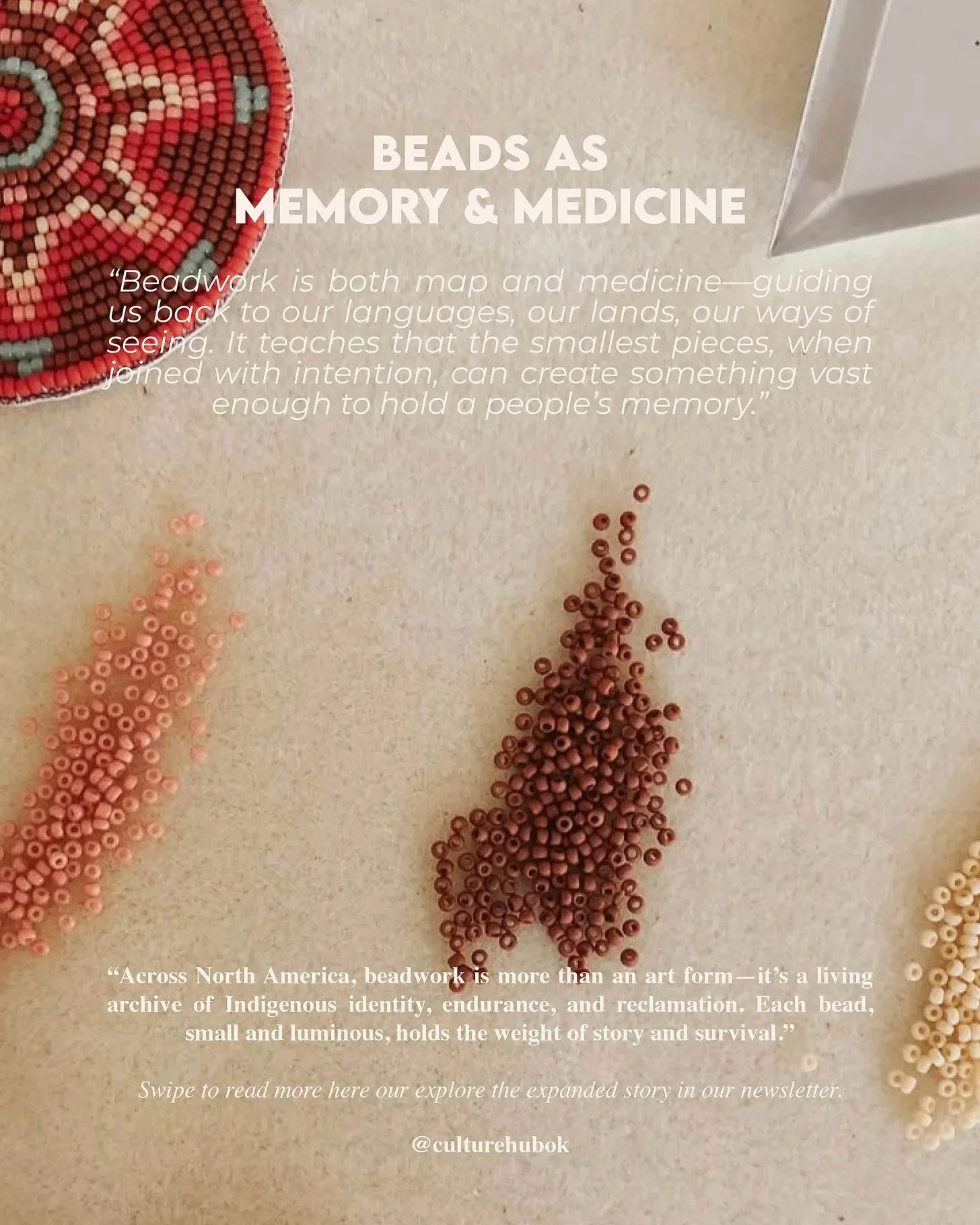
Across North America, beadwork is more than adornment—it is a living archive of Indigenous identity, endurance, and reclamation. Each bead, small and luminous, holds the weight of story and survival.
Long before glass beads crossed oceans, our ancestors adorned themselves with shells, stones, bones, and quills—each chosen for its meaning and relationship to land, kin, and spirit. When glass beads arrived through trade routes in the 16th and 17th centuries, they were quickly integrated into existing traditions. Traded for furs, goods, and sometimes survival itself, beads became both currency and connection. But we did not simply adopt them; we transformed them, infusing our own languages and designs into their shimmer.
Through centuries of colonization and attempted erasure, beadwork endured—quietly, defiantly—stitched into hems, sewn into regalia, tucked into bundles as proof that our hands and hearts were still our own. When ceremonies were banned and languages forbidden, beadwork became a quiet form of prayer and protest. Women, grandmothers, and two-spirit makers stitched meaning into every garment, transforming something as fragile as thread into an unbreakable line of continuity.
To bead is to pray, to remember, to rebuild. It is the steady rhythm of thread pulling through fabric, a pulse of survival. For many who have been distanced from their tribal communities, beading is a way home—one stitch at a time. Each pattern is both ancient and new: a contemporary echo of what has always been. The work calls forth old songs from sleeping places and teaches patience, humility, and devotion.
In community spaces, beads spill across tables like tiny constellations. Laughter, stories, and soft instruction mingle as elders and youth bend close together. The smell of coffee and hide, the glint of glass under light—these are sensory ceremonies, spaces of healing. Beadwork reminds us that art is not separate from life; it is life. Every piece, whether for adornment or offering, carries the fingerprints of lineage.
From the floral designs of the Woodlands to the geometric patterns of the Plains and the raised beadwork of the Northeast, each style reflects geography, language, and worldview. Today, beadwork continues to evolve—adorning runways, protest lines, and powwow grounds alike. Contemporary artists blend traditional techniques with modern materials, carrying forward the same message: We are still here.
Beadwork is both map and medicine—guiding us back to our languages, our lands, our ways of seeing. It teaches that the smallest pieces, when joined with intention, can create something vast enough to hold a people’s memory.
Each bead stitched today extends a thread back through centuries of creativity and care. It is a reminder that even under the most brutal conditions, art has always been a form of resistance—and love has always been a form of survival.
We invite you to join us for an afternoon of beadwork, tea, and togetherness at Culture Hub’s Harvest Bead & Tea.
At this gathering, we open our circle to both relatives and non-Indigenous neighbors alike. Together, we’ll share stories, learn, sip tea, and create side by side. Whether you’ve been beading your whole life or are picking up a needle for the first time, your presence matters—you are part of this living story.
Your participation supports Culture Hub’s ongoing work to uplift Indigenous artists, protect cultural knowledge, and nurture connection through art.
We hope you’ll join us, take a seat at the table, and add your light to the circle.
Who: Culture Hub Collective
What: Harvest Bead & Tea
When: November 15th, 2025
Where: 228 SW 25th St, Oklahoma City, OK 73109
Why: In support of Culture Hub Collective
How: Visit the link below to learn more and reserve your ticket!
All are welcome. Bring your hands, your heart, and your curiosity—we’ll provide the beads, the tea, and the warmth of community.